
Marvel’s Union Jack Problem
… and how they don’t seem to have an authentic read on stories set in Britain

Something different in this entry of “The Long Box.” This is a long one. I promise that if you make it to the end, there’s a reward.
Every time Union Jack shows up in a Marvel comic these days, I want to like it more than I do. Each time I close the book, I feel mildly disappointed, though never surprised. He is, after all, in Marvel’s chronology, Britain’s first masked hero. On paper, from his stated origin, Union Jack should be one of Marvel’s most interesting characters. In reality, he’s an object lesson in how Marvel has historically mishandled and even squelched potential.
Let’s pause the analysis here so I can give unfamiliar readers a potted background of the character’s history and his iterations.
Union Jack first appeared in The Invaders No. 7, Marvel’s titular World War II team of Nazi-fighting marauders, alongside familiar faces such as Captain America, Namor the Sub-Mariner and the Human Torch, the android precursor to the Fantastic Four’s Johnny Storm, who are in the U.K. saving us all from being bombed in true Yankee style. (Wow. Thanks so much, lads.) Cue a coincidental, yet suspiciously convenient, encounter with the vampiric Baron Blood. More on him later.
Thus, in due course, we are introduced to Lord James Montgomery Falsworth, the first Union Jack. Cue a couple of pages of exposition where, given it’s wartime, the aging aristo carelessly dives into recounting his “secret” former life as the famous “masked spy-buster” of World War I. Yep, even the android Human Torch knows who he is thanks to coverage in American tabloids.
So, a spy who operates in a loud, flag-covered uniform behind enemy lines as a special operative of His Majesty’s government, whose work is public enough to make foreign newspapers. Ridiculous and contradictory, yes. This is a superhero comic from 1976, where logic takes a back seat to action.
Lest we misremember the period’s excesses, I should note that this was the year Stan Lee gave his blessing to the release of the cringeworthy album Spider-Man: Rock Reflections of a Superhero (narrated by the Man himself). Just go with it.
Later in WWII, UJ#1 joins a team of masked heroes known as Freedom’s Five. You don’t need to remember this. We won’t be meeting them again.
Baron Blood, however, is the one Bosch nemesis they couldn’t defeat. And he’s back.
Big Bad set-up: achieved.
Story arc: employed.
The Invaders No. 8 has an absolutely smashing cover by Jack Kirby showing Union Jack standing like Nelson on his column, surrounded by his teammates-to-be, with a token background featuring Big Ben, presumably because nothing is more identifiably British. Cough.
At the end of it, having partially vanquished Baron Blood and despite acknowledging he’s a bit past his prime, Union Jack is accepted onto the team. Flag-waving patriots unite.
Look, I’m being a little sarcastic because you readers eat that up. Still, the art here by Frank Robbins, with Frank Springer on inks, is cracking, and the action, intrigue and interpersonal drama snap along thanks to Roy Thomas’ script.
Slight aside: did you know an android can be hypnotized?
And this is, in large part, my Union Jack. Effective, strategic, charismatic, efficient, right up until he gets his legs crushed when Blood slams a boulder down on them.
Oh, my man. They did you dirty. You were just a device to move the plot along. A glorious two-dimensional creation.
“I knew just what I wanted this WWI and WWII English hero to look like, a walking Union Jack flag, so I drew that costume on one of the hero layouts or stats that John Romita had designed for such purposes,” Thomas said about Union Jack’s creation. “Frank Robbins was the first person to draw the character on the actual page, from my sketch, and then I was lucky enough to get Jack Kirby to draw the cover. Wish I’d saved my original drawing.”
When the costume passes to Brian Falsworth and later to the working-class Joey Chapman, who is Union Jack still, what follows across decades of appearances is familiar. Vampires. Gothic inheritance. Old curses seeping out of the fog. These aren’t bad stories. They’re simply the wrong ones. Moribund. Stuck in a rut. Chapman just seems to happen into the role, leaving his art school student days behind.
Yes. Apparently, all the experience that’s needed is a pencil, ruler and paints. That may also have been Steve Rogers’ beginning. At least he got a dose of that there super-soldier serum.
(Blade, who you may be unaware was born in a Soho brothel and is as English as I am. Soho is in London. You’re welcome, American readers.)
Union Jack becomes a vampire hunter. The costume shifts somewhere around the ‘90s and the Pendragon era to something more militaristic, then returns for a couple of specials, then reappears during … erm … I dunno. Something to do with a recent Marvel cross-promotional event where vampires take over. I’ve lost track.
Each appearance feels like Marvel reacting to a fan outcry for a decent Union Jack story by handing the reins to the least capable creative teams available. “Look, just do something, anything, to keep them quiet for a while.”
The high point is perhaps Ben Raab and John Cassaday’s 1998 Union Jack three-issue miniseries. Baron Blood again. Vampires again.
Not even art-genius Cassaday can deliver us from the typecasting.
Here we arrive at one of Union Jack’s central problems, the creative teams behind his outings. For many writers, being handed a Union Jack assignment must feel like punishment.
As far as I’ve been able to research, all but two of the numerous teams who have worked on a Union Jack story come from somewhere other than the U.K. No wonder the work feels phoned in.
A nod here to Wolverhampton’s Mike Perkins and Paul Grist, who valiantly tried, really tried, with The Union to create a compelling superhero team helmed by UJ. I don’t know much of the history behind that run, though I do know Grist was hammered unfairly on social media before the book even came out. His storytelling, uncoupled from his unique art, was meh.
It hasn’t helped that Union Jack, a second- or third-tier hero, has had to compete with the superpowered bruiser who’s become the U.K.’s most well-known export, Captain Britain. That character was, essentially, as British-built as a Robin Reliant, and helped cement the brilliance of two of the finest British comics creators we exported to the world, Alan Moore and Alan Davis.
Because of that success, Cap, while created by Chris “Isn’t-Actually-English-Although-He-Thinks-So” Claremont and the legendary Herb Trimpe, received the lavish attention and truly brilliant world building from British creators that Union Jack never did.
Initially created as a flagship for the Marvel UK lineup, Captain Britain would later go on to become massively popular.
Captain Britain monthly’s 14 issues, published January 1985 to February 1986, have pride of place in my collection and were hugely influential on me as a young artist.
Union Jack doesn’t appear at all in that run. He turns up later in the eminently forgettable Knights of Pendragon (1990), reduced to a source of class rivalry between the aristocratic superhero and the working-class Joey Chapman incarnation. It’s an insipid foundation for tension unless handled with care.
Then the 1990s ruined comics. Marvel UK produced a burst of original characters that appealed to pretty much nobody. Only Death’s Head retained a degree of loyalty, until he was rebooted. Marvel UK sputtered and faded out.
By then, I’d long since stopped reading comics.
Somewhere in there, mainly around the era of “Cool Britannia,” I found myself perseverating on Union Jack and a storyline that could not only reboot him as a viable British character, but explore the missed opportunities of the Falsworth legacy.
Union Jack, the gentleman spy. A British wartime operative shaped by secrecy, institution and tradition. A hero whose power isn’t mysticism or brute force but access, memory and experience.
Strip away the costume and Union Jack’s DNA is clear. James Montgomery Falsworth is a product of the early 20th-century British state, World War I intelligence work, World War II alliances, aristocratic obligation and institutional loyalty. He understands secrecy not as mystique, but as policy. He operates inside systems rather than above them. He is driven by principle.
And what if he wasn’t the first?
I won’t bore you by laying out the arc in detail, as much of it lives only in my head and in small notations in my notebook.
Besides, I know full well that Marvel would never allocate the resources the idea would need to succeed. I’m just some jerk with a keyboard, warrioring and worrying away on some internet blog.
Still, I have to give it a try. A little bit. Using crime.
If you’ve read this far, thank you. I appreciate you letting me blast on about one of my favorite mishandled characters.
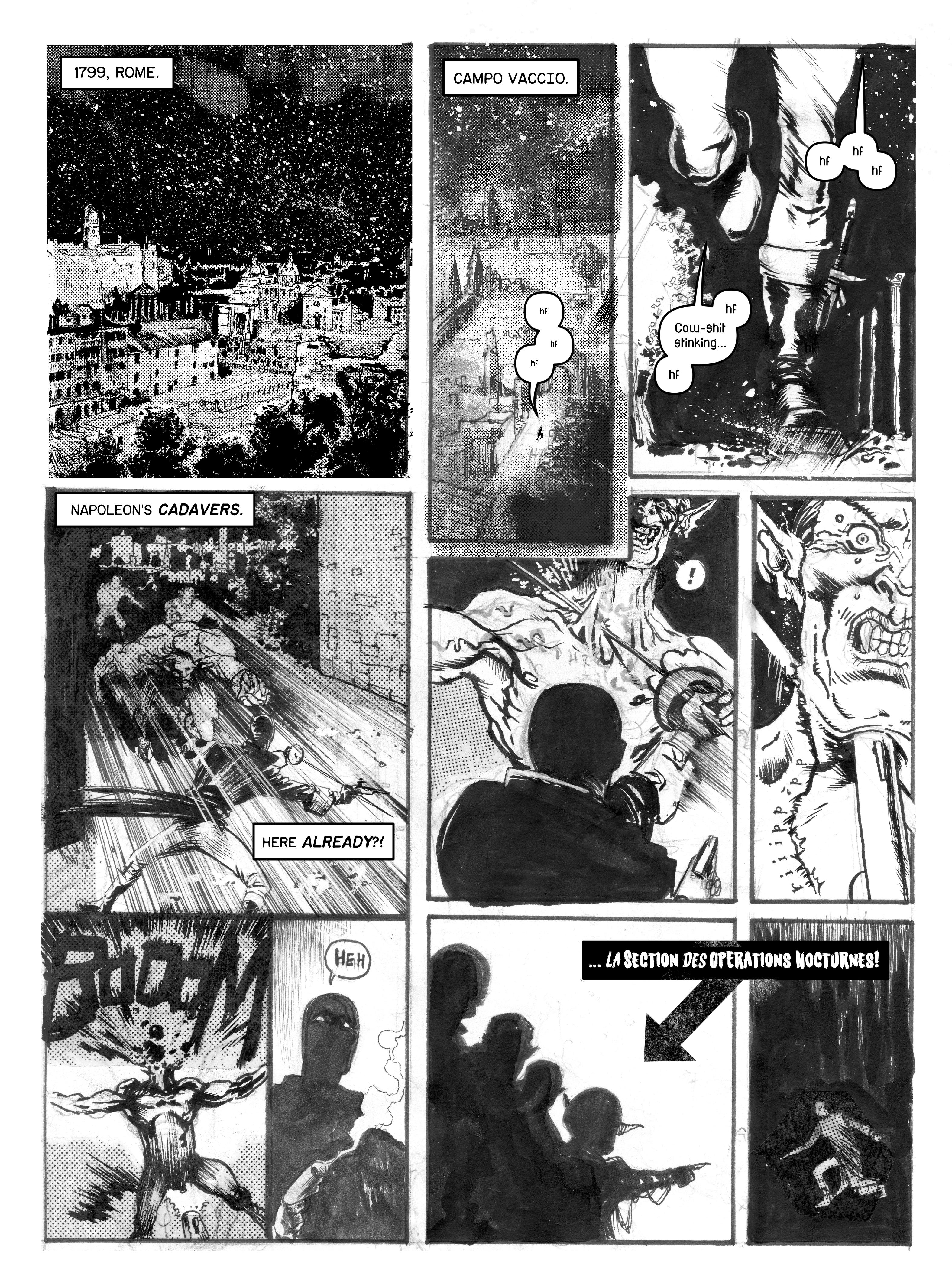
As a reward, below is the first page of a bootleg Union Jack story, even though the words “Union” and “Jack” won’t be found in the pages to follow. (Because history.) This is an homage to the country that birthed me, warts and all, and to its culture and people.
Hopefully Marvel won’t get all legally pedantic about me using a version of one of their C-list heroes and shut this down.
I doubt he’s going to make it to the MCU anyhow.
I give you: No Place for a Gentleman.
You nail the problem with the character - 'unless handled with care'.
Costumes based on flags are inherently problematic and the Union Jack has additional complications. Some people view it as a symbol of national identity whilst to others it's a symbol of occupation. Most flags are blood-stained and that one is particularly bad.
'Cool Britannia' just doesn't go down that well in parts of Ireland, Wales and Scotland. It's very telling where the term geographically originated.
The Union Jack is highly associated with class, racism and violence across the British Isles. It always has been. All of that complicated politico-cultural baggage does make for greater depth of story and it's easy to sprinkle in, but in the hands of a less nuanced writer steered by a corporate entity it very quickly feels insensitive or ethnocentric. I agree with Tony's recent citing of Hanif Kureishi, writers should provoke thought and should shock. Marvel is absolutely the wrong place to do it. A Union Jack comic could be great as it holds the mirror up.
I think about this a lot for the comics I make about costumed characters in the (former) UK. Very quickly it can get bogged down by overthinking or worrying too much about pleasing people. I think I fumbled the ball a lot, so I just try and keep it simple. I got round it by seeing the story as a fairy tale.
Your page looks great - I love that design.
PS I don't find it the easiest costume to draw, particularly around the deltoids and crotch.
Fantastic. Really fantastic. I'm a 90s kid who grew up with the Image adjacent glut, so I have the softest spot for Starman. I understand that niche character you fall in love with. Hell, when I was producing fan fiction back in the day, I came up with a 60 issue Hourman series, because Rick Tyler is the G U Y. I need to dig that out and see if I can repurpose it...
Union Jack is great. Grist's Jack Staff is better. It's a shame his Marvel outing was tied to King in Black, that really DOA'd a dream project. I know I missed it (regrettably).
Your bootleg looks great. Your views on the character are brilliant. Reminds me of what Grant Morrison (and Paul Cornell) did with Knight and Squire. Just great stuff.