
Comics' latest gold rush
Rarity that isn't real, we don't learn from history and why I hatehatehate variant covers

Variant covers.
Everything I despised about ‘90s comics, all conveniently captured in two simple words.
Variant. Covers.
The dawning of the 1990s, coming as it did after the late ‘80s resurgence, seemed to promise a new era of Comics as Literature. A form long derided as being “For Kids” had a new wind in its sails and seemed, finally, to be gaining a similar degree of respect as it already enjoyed in more classy European cultures. What had been a mass-produced pulp medium for entertainment was now being debated, critiqued, reassessed as its own legitimate art form. Comics had value. Comics were cool. Comics were, once again, making money.
Yadda, yadda, “Watchmen,” “The Dark Knight,” “Maus,” etc., ad nauseam.
Comics were flying off the shelves in large part because an influx of cool British writers were bringing ideas from outside the closed shell of North American creatives: Moore; Morrison; Wagner; Milligan; and (ugh) Gaiman. And with them, the standard lines of American artists, carefully curated over the decades into “House Styles,” were being redrawn — literally — by UK talent: Gibbons; Bolland; Dillon; and Davis (my love, my heart).
All this was seen and curated by the visionary DC comics editor Karen Berger into a showcase of these new perspectives: Vertigo Comics. Adult, deep, mature, violent, surreal, macabre, psychological, magical, challenging. Glorious times.
Then the vultures arrived and all of that, all of it, went to shit because capitalism.
(Stick with me. I know you know all this, because you’re the kind of people who read The Long Box and I’ve said all this before. But I’m building to a point, I promise, and this context, as repetitive as it is, is relevant to a present day furor.)
The other defining hallmark of the 1980s was that greed is good, that twisted maxim of the rapacious sociopath Gordon Gekko, he of the Oliver Stone movie, “Wall Street.” (What comes around goes around, I guess.)
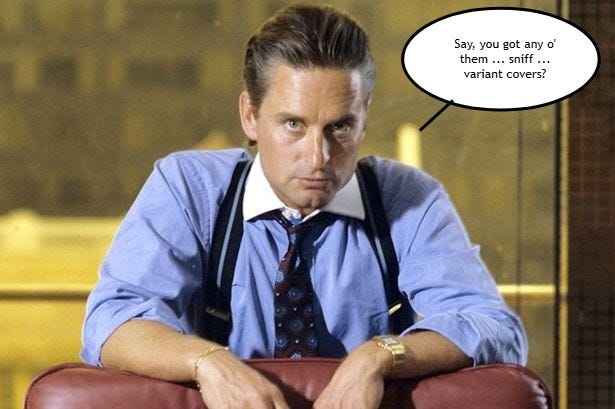
People in comics, which had been an industry in attrition through the ‘70s, and those outside of it suddenly smelled opportunity — and money. Suddenly, comics became predatory. The corporations behind the comics industry leaned into collectability and artificial scarcity. The idea that comics were an investment, rather than mass-produced entertainment, became a weapon to aggressively milk the market. Infamously, kids were led to believe their collections would eventually pay for college.
Wizard Magazine featured a glossy monthly price guide that used literal stock-ticker arrows pointing up or down to show how much a comic’s value had changed in 30 days.
I’m nearly there. Stay with me.
Gimmicks abounded. DC killed Superman in 1992, and mainstream news like CNN and The New York Times ate it up, adding gasoline to the speculative fire.
Rockstar celebrity creators (fuck you forever, Jim Lee and Rob Liefeld), sensational “this will change everything forever” issues, trading cards, crossover “events,” “do not open” first-issue polybags and ...
Variant covers.
How I fucking hate variant covers. Foil, wraparound, holographic, embossed or die cut, gatefold, glow-in-the-dark, acetate. All of them.
This still, to me, reeks of just how insidious the whole scam was. Just the thought of how the industry targeted vulnerable, neurodivergent completists and enabled others makes me sick.
Variant covers.
The ultimate weapon of the speculator boom.
And they took a massive shit on retailers, too, who, trapped by the direct market, were forced to riskily order thousands of printings to access the “rarer” variants their customers wanted. What a shakedown.
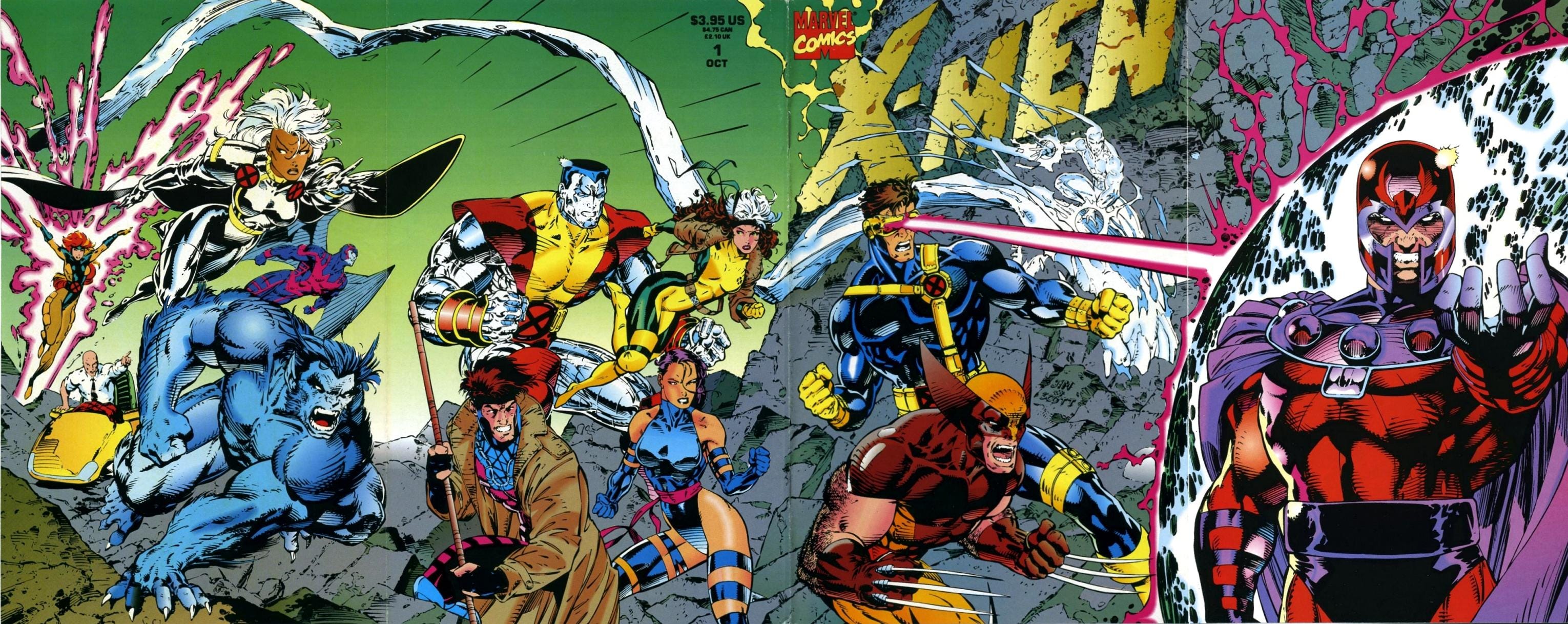
This all began with “X-Men” #1, in August/September 1991, drawn by Lee, who had become an overnight celebrity with his debut on “The Uncanny X-Men” (different book) in 1989. The digitally colored interiors (the first of their kind) and high-quality glossy magazine paper were wrapped in four separate interlocking variant covers, all drawn by Lee, which, when placed together, formed a massive battlefield image. In addition, a fifth premium gatefold version combined the covers together as one.
So, in order to have a complete run of just the first issue, a collector would have to shell out for five editions. All with the same interior.1
X-Men #1 sold 8.1 million copies. That’s a Guinness World Record that still stands today. Scarcity my ass.
And you know what happened next? They nearly fucked the whole industry.
Enough history. I just needed to bring you up to speed so I can appropriately frame what follows, and yes, we return to ...
Variant covers.
And also greed. And also capitalism. And also the tendency for history to repeat itself and for us to ignore it, thinking Things Will Turn Out Differently This Time.
I’ve written before on how, at a smaller scale, DC’s Absolute line has recently reenergized a flagging medium, particularly sales of “Absolute Batman.”
The problem is that the systemic problems of the direct market are still around. So is capitalism, and so is that tendency to make as much money as possible before it all goes tits up once again. This is why we can’t have nice things.
We come, now, to Covergate. (Such an original suffix.)2
The relaunch of Batman as a flagship of DC’s Absolute line created a volatile speculative market in its wake: initial issues regularly sold upwards of half a million copies.
Secondary market prices for recent raw issues quickly escalated past $300 a piece. Retailers commissioned an unprecedented volume of store-exclusive variant covers.
Let me step back just a tad and explain one weird facet of the industry: physical comic shops, online dealers (remember this, it becomes important), convention organizers and even prominent creators can contract directly with major publishers to print limited-edition, custom-made covers. These are officially referred to as “Store Exclusives” or “Retailer Exclusive Variants.” If approved, the retailer can commission an artist to develop a unique cover.
Money, lots of it, is naturally involved, because capitalism. The retailer’s investment is steep (artist costs, wholesale kickbacks) and risky (unreturnable issues), but not without benefits (a shot at receiving other rare incentive covers from the publisher, etc.).
(If you’re sensing a little unfamiliarity leading to over-explanation on my part, you are correct. I don’t buy a lot of comics any more and had no idea this was a thing. Ignorance is bliss; now I must for good or ill march forward with this new knowledge.)
Enter Mark Brooks, an Inkpot Award-winning American comic book illustrator and designer.
Brooks found a loophole. (Remember when I told you to “remember this” a couple of paragraphs back? OK, activate your recall.)
Anyone with an e-commerce platform and tax ID can register as a “retailer.”
Brooks set up his own storefront, “Mark Brooks Art,” and established a direct sales account with DC. Now, this isn’t anything new, to be honest. Artists like J. Scott Campbell and Alex Ross have done the same thing.
So why is Covergate a controversy? Because Brooks glommed onto the hottest, high-margin book currently on the market: Absolute Batman.
Clever, clever girl.
Brooks commissioned Jock, a superstar in the field and a personal friend, for a wraparound cover for issue 22 in a 50-50 split of the proceeds. (Jock is well-known for his work on DC publications with Scott Snyder, Absolute Batman’s writer, so, reunion synergy.)
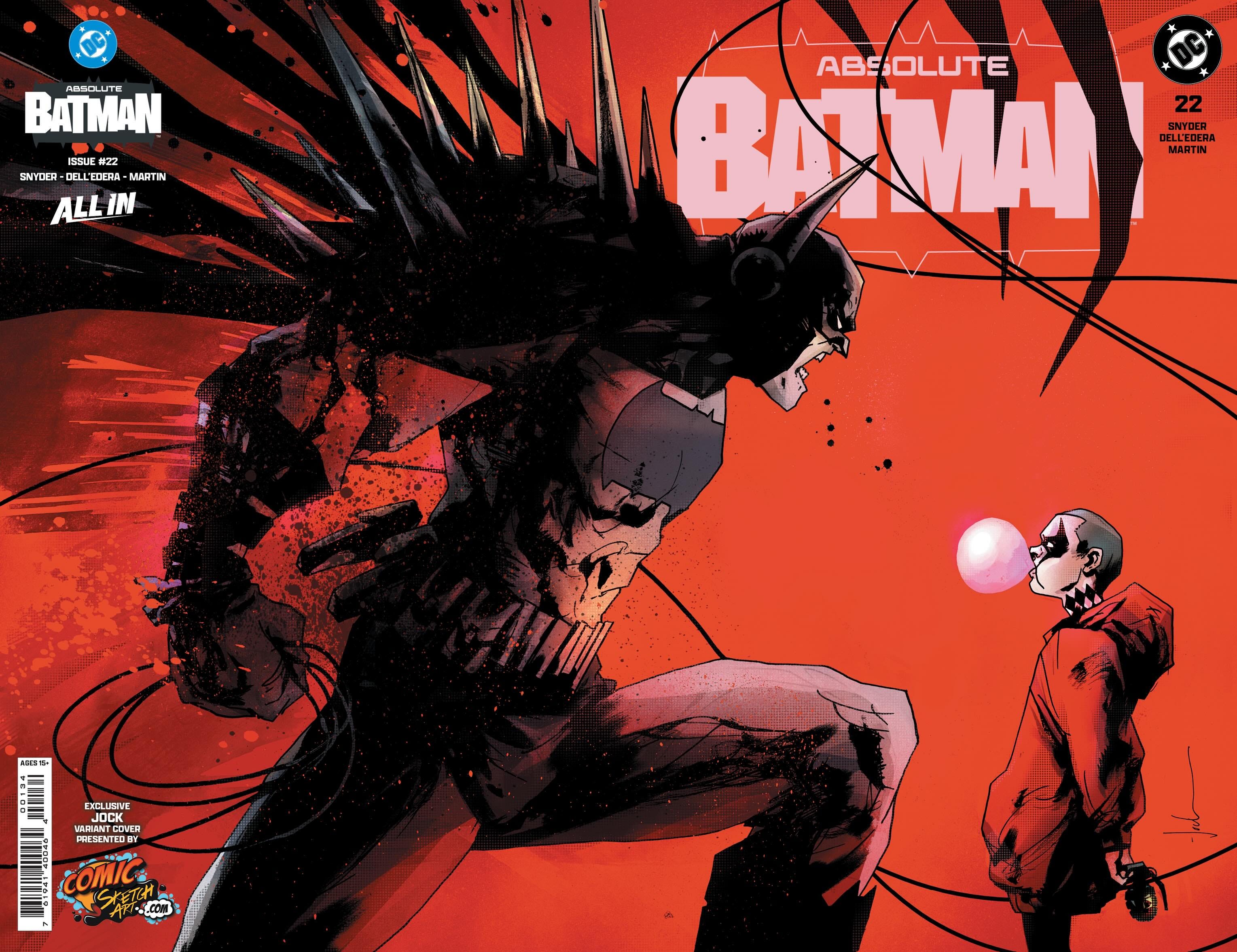
You can buy this cover through Brooks’ store in a cardstock trade dress ($50; $70 signed), or virgin foil ($65; $85 signed; $235 with a custom Jock sketch), or as a collector’s bundle (up to $200 with a “mystery item”).
Then Brooks did it again with a variant by Andy Kubertzzz … Oh, damn, sorry, nodded off there.
Honestly, the audacity. You kind of have to admire the bravado. Neither cover is all that good. (I say that with no disrespect to Jock or Kubert, who are masters of the craft; I say it because neither cover a) Is worth that price; b) is worth this degree of drama.)
Of course, just about everyone is pissed, retailers particularly. I’ll let you do your own research on the controversy. Let’s just say the way Brooks announced the whole thing was a complete miscue. It didn’t help that that eternal outrage grifter Rob Liefeld piled in with his 2 cents (about double what his opinion’s worth).
From my perspective, blaming Brooks, or even Jock (he’s just an artist; what does he know about business?) misses the underlying problem: the direct market’s reliance on speculative collection, which has driven the idea of comics as an investment, as chimerical a reality today as it was in the ‘90s.
Like diamonds, there’s no real scarcity. It’s a convenient fabrication. What Covergate shows us is the uncomfortable truth about ourselves more than anything, and the economics of the culture in which we live.
The true value of comics is in the stories, in the words and lines, in how they make us feel, in the community of readership and our love for the characters and worlds opened up in their pages, and the history of the medium and those who have been torn up along the way because of their impossible, unfathomable passion for this remarkable, ancient pastime.
I only wish the whole thing didn’t rest on deception and piles of cash.

There’s a whole history here I won’t bore you with, but Lee came onto the book and overnight, everything shifted. Marvel realized an important truth: art sells books, not writing. Chris Claremont, who over 16 years had revitalized the X-Men into Marvel’s flagship comic was suddenly playing second fiddle to a superstar artist whose flashy layouts sold books faster than his scripts ever could. Claremont’s massive ego couldn’t handle the disrespect and he walked. 1991’s X-Men was created for Lee to play around in as an unrestricted sandbox. Style — not substance — became the defining approach in ‘90s comics from then on. (I stand by my absolute, incomparable loathing of Jim Lee’s work.)
There’s broader context about covers here that bears deeper discussion; for now, I’ll frame this as a sidebar.
The modern comic book cover is caught in a profound identity crisis, and nothing illustrates this cultural fracture quite like the recent uproar over the front of “The Amazing Spider-Man” #1,000, drawn by industry titan John Romita Jr. Fans blasted the street-level, foreshortened perspective of a swinging Spider-Man, joking that his scrunched shoulders made him look like he was merely shrugging at his own milestone.
The backlash grew so intense that rumors swirled Marvel was pulling the art entirely. This sparked a fierce counter-protest from professional creators, who publicly condemned the move as a dangerous capitulation to online bullying, defending the art legend’s right to experiment. Caught in the crossfire, Marvel compromised by releasing two primary covers, which pacified the mob but exposed a broader reality that readers have felt for years: modern comic covers have lost their narrative soul.
In the 20th century, a cover’s sole job was to scream a story from a crowded newsstand, using high-stakes melodrama and shocking teasers to hook casual readers. Today, the industry relies on a captive audience of dedicated subscribers and speculators.
Consequently, narrative drama has been replaced by static, stylized character pinups that say, well, nothing about the plot inside.
This is fueled by that hyper-lucrative variant market, where a single issue might launch with dozens of alternate covers. For me, there’s a stunning homogeneity and zero curb appeal, especially when the interiors are possibly more vacuous than the covers. (Or so I hear. I don’t buy anything from Marvel or DC anymore.)
Can’t disagree with a word of that, Clifford. IMO it’s this greed that degraded the cultural value of the average comic cover to that of wrapping paper.
The Pop Artists would find nothing to riff on in all this narrative free pap - it’s already emptier than a Lichtenstein
Good piece.