
AI stings the Eisners
... and why the debate over Stardust is focusing on the wrong thing

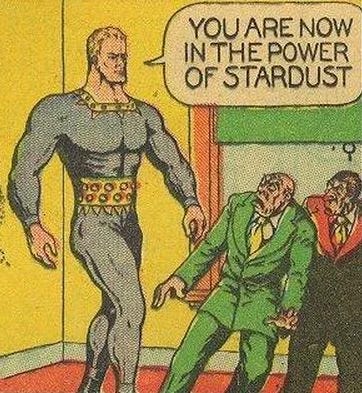
Should AI be allowed in comics?
That’s clickbait. The only answer is no. But despite the growing consensus that it’s not, AI evangelists still keep trying to slip it in. This time, it cost one publication an Eisner nomination.
The reaction to the use of artificially generated imagery in comics and the art ecosystem beyond seems to be an overwhelming “FUCK NO.” Cons are banning AI; the Big Two, Marvel and DC, are as well — after backlash. Ahoy Comics and Oni Press have adopted cartoonist Matt Kindt’s “100% Human-Made” campaign, running the associated logo on their publications.
I share that hard line in the sand.
That said, I am very old. My sensibilities don’t always dovetail with present culture. To me, the “debate” around AI “art” seems self-evident simply from the perspective that AI cannot create, not in the oddly alchemical way that humans perceive and connect often disparate inputs into something completely original.
At best — for now — AI is good at collating, reorganizing and re-presenting information efficiently, with about the accuracy of a bright if mildly indifferent and easily influenced high school intern.
Poisoned pill page
Somehow, a completely AI-generated page was included in an Eisner-nominated anthology, Stardust the Super Wizard, which had been, until it was withdrawn, nominated for Best Anthology. Titled “Artificial,” the page was … well, “created” doesn’t seem like the right word, so let’s go with “generated” … by Michael Todasco, using his AI persona “Alex Irons,” by training the AI on Stardust creator Fletcher Hanks’ 1940s artwork1.
(I’m not quite sure what’s meant by an “AI persona” and I’m too indifferent to ask, but it sounds shady.)
Todasco is, for his part, the only creator who used AI — one single page among 140-plus pages, or about .7%, filled with contributions from legends including Mike Allred, who supplied the cover artwork and an interior story, Francesco Francavilla, Pete Woods, Ron Marz, Zander Cannon, Cecil Castellucci, Shaky Kane, Jesse Lonergan, Derf Backderf, Jeff Parker and Tom Fowler.
Editor Van Jensen, to his credit, rescinded the anthology’s Eisner submission in May, removing the book from contention. That was the ethical move, as painful and frustrating as that must have been.
But the damage has been done. The controversy of that one page has all but erased the conversation we should be having about the contributors’ work, now cancerously tainted by proximity. And I recognize that I’m contributing to that misalignment of focus2.
Todasco, for his part, appeared at best ambivalent, at worst uncontrite about the fallout; I’m not entirely sure he really grasps the fuss, appearing as flat and emotionless as his AI creation. If he feels any remorse, he hasn’t spoken of it….Bad machine is bad
As a follow-up experiment, Todasco had “Alex Irons” write 19 books.”(The books) ‘Alex Irons’ has written are not things that I would actually read,” he told Publisher’s Weekly.
I don’t know that he understands the ironically charged cognitive dissonance of that statement (or hasn’t run it through ChatGPT so he knows what to think). I’m frustrated on a number of levels that I’m having trouble understanding exactly what he means by that zen-koan-like admission.
The foundation of art is that mysterious exchange between creator and viewer, that which is to be experienced and those that experience it, even if the recipient is the creator (and I use the term loosely with respect to Todasco). When the creator is indifferent to creation, then what’s the point?
Madness. Intellectual masturbation.
From what I’ve read, the inclusion was intentional on Jensen’s part, indicated by his additional statement that his “personal view of AI changed” during the book’s development.
And the page is noticeably a piece of dogshit. The telltale hallmarks of AI generation are evident in the inconsistent, border-breaking lettering and changing characters and the egregiously asymmetrical layout that slices off the top of heads. Todasco may have “trained” the AI on Hanks’ work, yet it is such a poor copy.
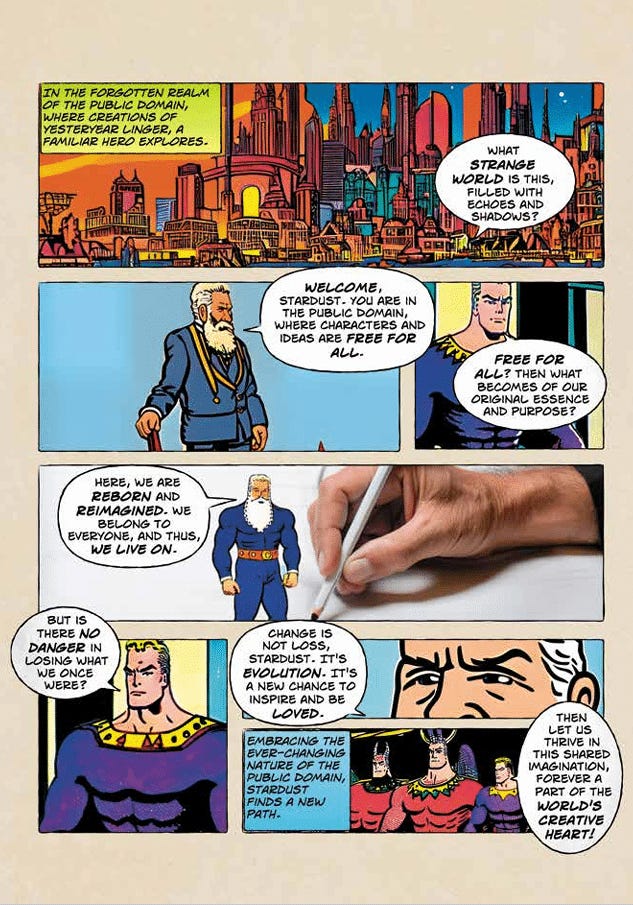
What exactly is going on here? The human hand clutching a pencil is particularly ironic.
More than 100 submissions were fielded and whittled down to 30 for the anthology.
The reaction to this one page of AI was, naturally, overblown. Many commenters flat out refused to buy the anthology or said that they wouldn’t have if they had known because of that single page (and thus shat copiously on the hard work of all the other creators involved). “Throw the baby out with the bathwater!” was the unnuanced refrain. I am, of course, paraphrasing. (I’ve commented before on cancel culture’s maddening zero-sum-game tendencies and won’t get into it further here.) Even if the AI page had been disclosed ahead of publication, the Eisner judging panel stated they would have voted against the anthology’s inclusion. (A little Monday mornin’ quarterbackin’ there, I think).
I should note that the reaction, as overblown and all-consuming as the dogpiling was for a hot minute, did result in at least the one positive outcome. The Eisner Awards organizers said they’d implement an anti-AI policy.
Dozens of really excellent submissions become, by default, inadmissible, the tree of the poisoned fruit, to subvert the legal jargon. And all the hard work put into that anthology by Jensen, all the associated talent and the 614 supporters who backed the project on Zoop to the tune of nearly $40,000 (from an initial request of $10,000), have been overrun in this hurricane of disapprobation over a single page.
Now, I understand the M&Ms analogy — would you eat a bag if one of the M&Ms within was indistinguishably made of a candy-coated piece of shit instead of chocolate? No, of course not. But we’re talking about a single page that could be skimmed over with no concurrent effect on health or well-being. But we are living with political litmus tests and the insanity of single-issue voters, no matter the consequence of defiantly taking that stand on the rest of us. There are more important hills to die on, especially given the growing consensus against generative AI in comics.
Dammit. I said I wasn’t going to get into commentary on the culture war. Moving on.
I do actually want to read a copy for all the human creators it includes, some of whom I adore and actively support. (See the second footnote, below.) Sadly, in the rush to condemn the whole publication (baby … bathwater, as mentioned previously), I and other readers who feel this is a bit of a storm in a teacup, must skirt social media condemnation from the online torch and pitchfork crowd.
I, for one, won’t rule out reading a book with an entire cadre of the field’s best and brightest simply for one side of a single page. If every anthology was judged by the weakest contribution of a single creator, anthologies would cease to exist. I’m not condoning generative AI in comics, not at all, but people, let’s bring some perspective.
Remember where I say above I may be out of sync with modern culture? Now you specifically know where. I’d even add, at no inconsiderable danger to my online reputation, that I would have allowed this publication to go through on the Eisner ballot had I been one of the judges. If there’s a slippery slope there, I can’t quite reason it through. (I’m sure someone will be happy to educate me.)
And while I won’t rule out the anthology, I do rule out AI.
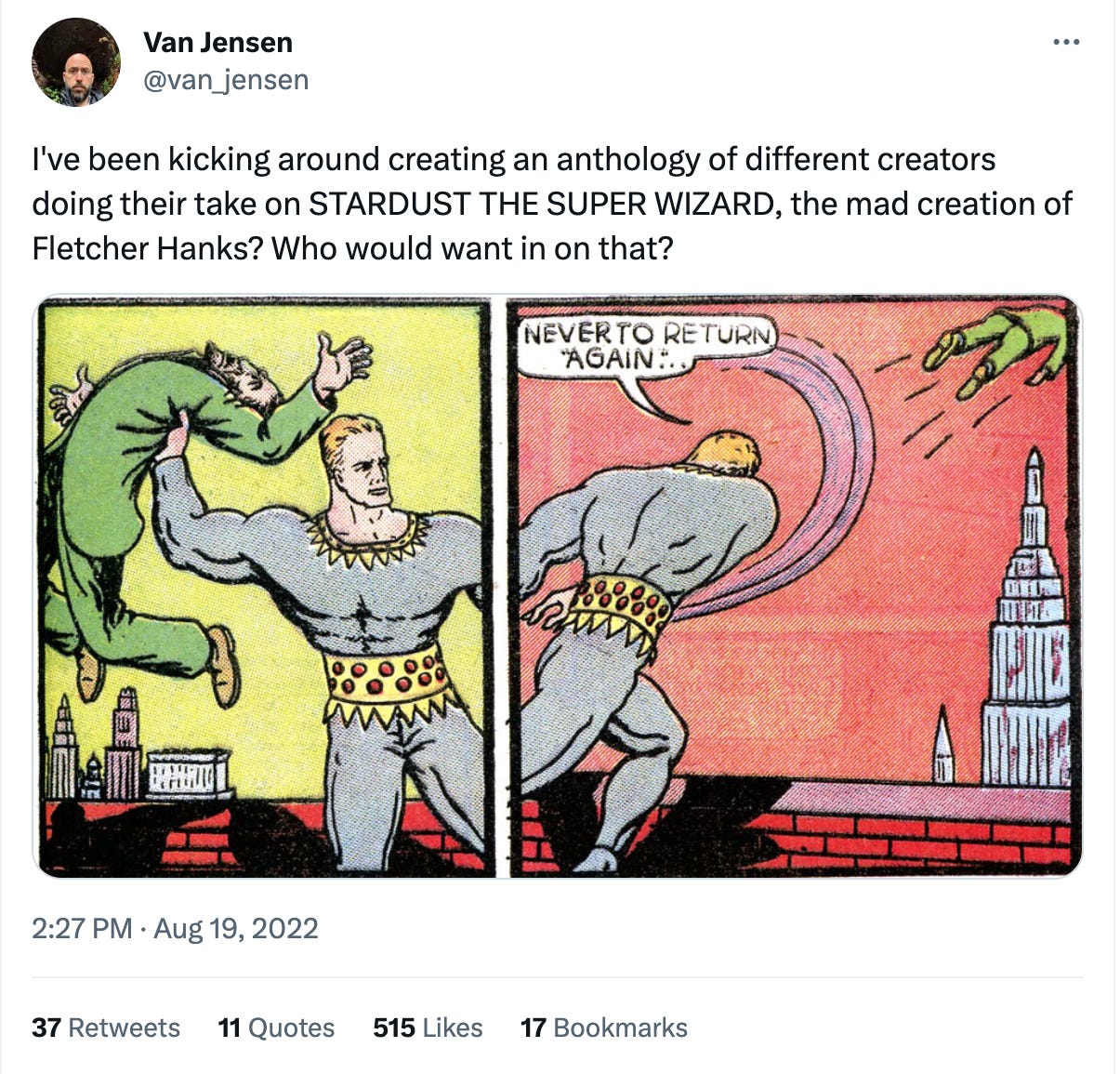
The tweet that started it all.
Hanks is a fascinating study. Born in 1887, he grew up in Oxford, Maryland, only a couple of hours away from where I live, on what’s called the Eastern Shore. He was violently abusive, an alcoholic who deserted his family, and came to comics later in life.
Then, after 51 stories written, drawn and lettered by him as a one-man assembly line, Hanks abruptly stopped and disappeared from history. We can only speculate why. He was found dead on a park bench in Manhattan in 1976. His work was completely forgotten.
In my defense, I reached out to Van Jensen to buy a couple of copies with the goal of a follow-up column to look at the other creators and where this AI controversy Will Not Be Further Discussed.
The M&Ms analogy is typically disingenuous hyperbole that undermines its intended point - “would you eat a packet knowing there was one empty shell in there?” is relevant question, but everyone wants to load their dice. It’s like we aren’t confident of the strength of our arguments so we have to throw in a little extremism!
The Eisner committee could have allowed the entry and commented on their judgement that it won/didn’t win an award for the pages made by humans and that an ai content was not part of the consideration either way, but they know that the comics bloggers wouldn’t accept them judging the work of humans without taking sides on a digression